Advanced protection through flexibility, programmability and communications.
The DFP200 is a digital relay system that provides distribution feeder protection, control, metering, and monitoring. It uses waveform sampling of the current and voltage inputs at 32 times per cycle. Incorporating multiple functions in one package eliminates the need for expensive discrete components.
The DFP100 is a digital protection, control, metering, and monitoring system. It uses waveform sampling of the current and voltage inputs together with appropriate algorithms to provide distribution feeder protection. The DFP100 incorporates the protection, control, metering, and both local and remote human interfaces in one assembly. This eliminates the need for expensive discrete components.
Manufacturing for this product has been discontinued. As an alternative, please refer to the F60,
Manufacturing for this product has been discontinued. As an alternative, please refer to the 8 Series and UR Family relays
Manufacturing for this product has been discontinued. As an alternative, please refer to the 350 or 8 Series relays.
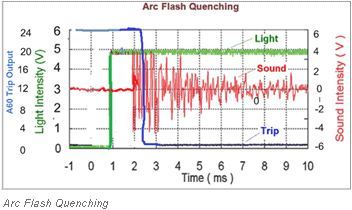
An arc flash event is the sudden release of electrical energy through the air. The resulting forces can produce temperatures up to 35,000°F, in less than one thousandths of a second, causing copper to turn into plasma expanding by 67,000 times. With these type of extreme events, fast, reliable arc flash detection is critical to avoid significant damage to equipment and reduce the repair and replacement costs, as well as downtime of the power system. The Multilin A60 Arc Flash System utilizes a unique sensing method that detects both light and pressurized sound signals that occur during an arc flash event, enabling more reliable and faster operating times to reduce the total arc energy generated. Utilizing a patented arc flash sensing method, the Multilin A60 is able to reliably detect an arc flash event in as fast as 1 msec.
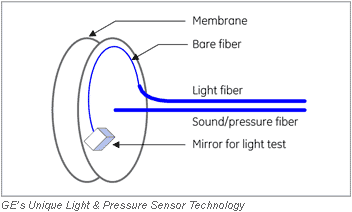
Based on a known time relationship between the speed of light and sound (pressure wave), GE Vernova's patented sensor is able to detect and issue a trigger signal to clear the fault in under 2 milliseconds – significantly reducing incident energy from an arc flash event. Specifically, the sensor head detects these two key factors (light and pressure wave) using LEDs, bare fiber and a membrane.
During an arc flash event, the diaphragm vibrates due to the pressurized sound wave creating a signature which is recognized by the Multilin A60. It is this unique combination of light and pressure wave detection that ensures reliable and fast detection of an arc flash event.
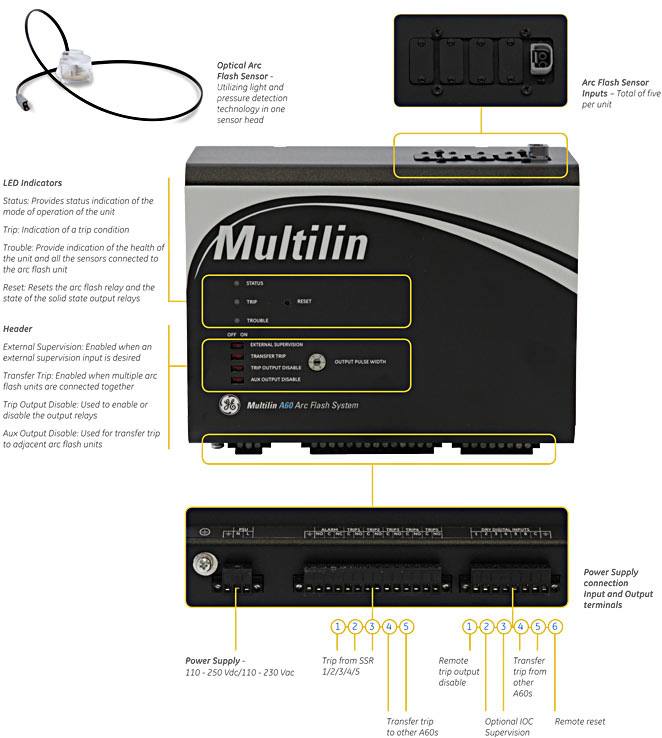
The Multilin A60 supports up to five sensors per unit providing optimal coverage in a typical two-high medium voltage switchgear section. To cover a larger area or for multi-section applications, Multilin A60's may be daisy chained together.
As a stand-alone unit, the Multilin A60 relay is DIN rail mountable and should be mounted inside the control cabinet of the medium voltage switchgear or motor control center. Sensors should be installed where there is a high probability of an arc flash occurring.
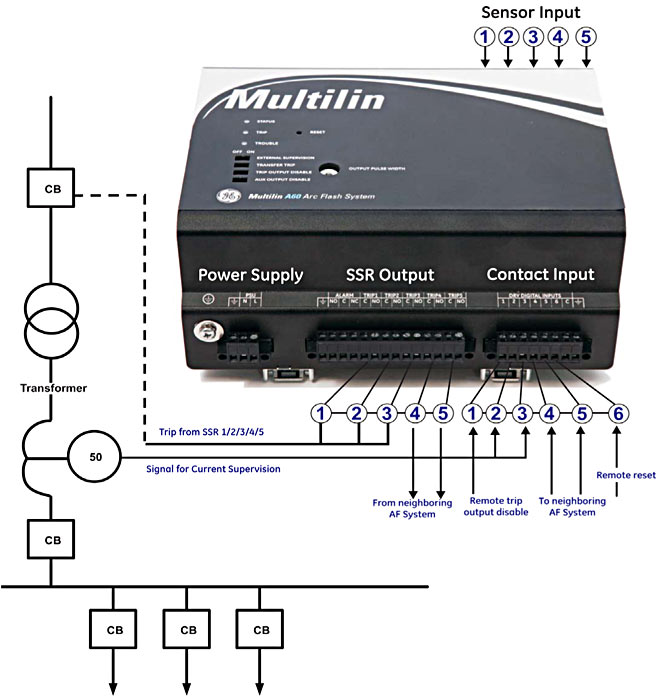
As the Multilin A60 utilizes both light and pressure to detect an arc flash condition, installation and wiring of external CT's are not required. An external current supervision from a separate Instantaneous Over Current (IOC) device may be used and connected as a contact input for enhanced security and mitigation of nuisance tripping.
The Multilin A60 provides an auto-calibration function for the sensors reducing total commissioning and testing time. Once installed and powered, the device will first run in calibration mode. This mode, sets the thresholds for both the light and pressurized sound based on surrounding or ambient conditions. As surrounding conditions may change, the Multilin A60 may be re-calibrated at anytime.
This figure shows the typical wiring diagram of the Multilin A60 Arc Flash System. The typical wiring diagram shows the connection of the input and output relays and the connected sources. The wiring diagram also shows the connection of the supervisory circuit (option) to the A60 unit.
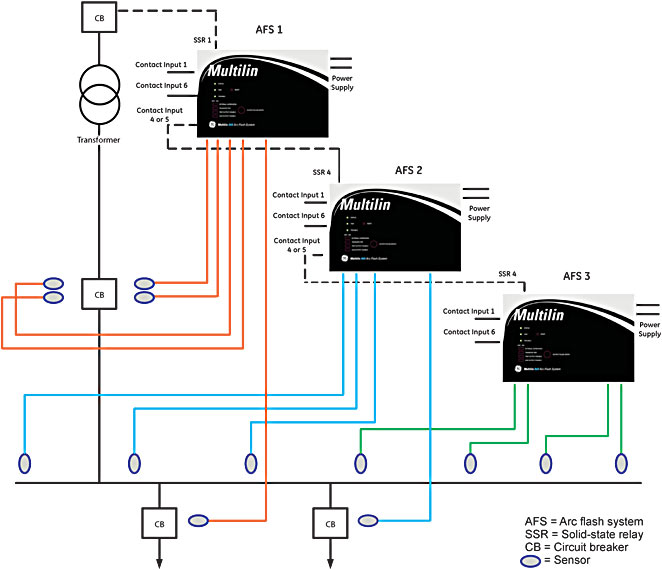
This application example below describes the ability of the Multilin A60 to be deployed in a cascading configuration across multiple MV switchgear sections and compartments, including through a substation bus bar vault. The Multilin A60 sensors should be installed at a certain distance from each other to ensure coverage of the entire bus bar.
By connecting devices together using the transfer trip input/output, individual Multilin A60 devices may receive a transfer trip signal from an upstream or downstream device, ensuring fast, reliable detection of an arc flash event in large MV switchgear applications.
Manufacturing for 750/760 has been discontinued. As an alternative, please refer to the 850.
The 750/760 Feeder Protection System is a digital relay intended for the management and primary protection and control of distribution feeders. This easy to use relay provides comprehensive protection functions for feeders and back up protection for bus, transformers and transmission lines at a reduced product life cycle cost.
The EnerVista™ Suite is an industry-leading set of software programs that simplifies every aspect of using the 750/760 relay. The EnerVista™ suite provides all the tools to monitor the status of your protected asset, maintain the relay, and integrate information measured by the 750 into DCS or SCADA monitoring systems. Convenient COMTRADE and Sequence of Events viewers are an integral part of the 750 Setup software included with every 750 relay, to carry out postmortem event analysis to ensure proper protection system operation.
Learn More
The 750/760 features advanced monitoring and metering functions which include:
Fault Locator
The relay uses captured data to calculate the type, distance to and the impedance of the fault. Records of the last 10 faults are stored.
Breaker Conditions
The relay calculates the per-phase wear on the breaker contacts to establish a threshold. When the breaker maintenance threshold is exceeded the relay can trigger an alarm. An alarm is also generated if the relay detects that the supervisory trickle current is not present. A failure to respond to an open or close signal in a programmed time can be used to generate an alarm.
VT Failure
The VT failure feature monitors each phase of input voltage, generating an alarm and sending the programmed output signals when a failure is detected.
Analog Inputs
Any external quantity may be monitored via an auxiliary current input. Two analog input level monitoring elements and two rate-of-change elements are available. When the measured quantity exceeds the pickup level, the relay can trigger an alarm or signal an output.
Event Recording
The relay captures and stores the last 512 events, recording the time, date, cause, and system parameters. Events may be recorded selectively by category, so that only events of interest are recorded.
Oscillography
A block of configurable volatile memory can be used for recording samples of the AC input voltages and current, and the status of logic inputs and output relays. This memory can be configured between the ranges of two to 16 blocks with 16 to 256 power frequency cycles of data respectively. The amount of pre-event data recorded is set by the user. Trace memory recording can be triggered by operation of selected features or logic inputs.
Trip Counter
The number of breaker trip operations is recorded, and can be displayed for statistical purposes (useful for units without operation counters).

The 750/760 is equipped with three standard serial communications ports, one RS232 located in the front panel, and two RS485/RS422 in the rear of the relay. A rear Ethernet port is also available as an optional feature. The front panel port allows easy local computer access. The rear ports provide remote communications or connection to a DCS, SCADA, or PLC. The baud rate of all the serial ports is variable from 300 to 19,200 bps. The optional Ethernet port can be used to connect the 750/760 to 10 Mbps Ethernet networks. The 750/760 supports ModBus® RTU, DNP3.0 Level 2, and ModBus® RTU TCP/IP protocols.
The three serial ports support ModBus® RTU protocol, while any one of the two rear ports but not both can be configured to support DNP 3.0 Level 2. The optional Ethernet port supports ModBus® RTU via TCP/IP protocol. The communication system of the 750/760 is designed to allow simultaneous communication via all ports.
Using Ethernet as the physical media to integrate the 750/760 to Local or Wide Area Networks, replaces a multipoint wired network (e.g., serial Modbus®), and eliminates expensive leased or dial-up connections, reducing monthly operating costs.
Various user interfaces facilitate operation of the 750.
Display
A 40 character display allows access to setpoints, actual values, and diagnostic messages generated by a trip or alarm condition. The 750 can display 30 user-selected messages during keypad inactivity.
Indicators
Twenty LEDs indicate relay status, system status, and trip and alarm conditions.
IRIG-B Input
This feature provides time synchronization via standard GPS clock inputs.
The EnerVista™ Suite is an industry-leading set of software programs that simplifies every aspect of using the 750/760 relay. The EnerVista™ suite provides all the tools to monitor the status of your protected asset, maintain the relay, and integrate information measured by the 750 into DCS or SCADA monitoring systems. Convenient COMTRADE and Sequence of Events viewers are an integral part of the 750 Setup software included with every 750 relay, to carry out postmortem event analysis to ensure proper protection system operation.
Learn More
Traditionally, retrofitting an existing relay has been a challenging, time consuming task often requiring re-engineering, new drawings, panel modifications, re-wiring and re-testing.
The 8 Series Retrofit Kit provides a quick, 3-step solution to upgrade previously installed SR 735 or SR 750/760 Devices. With the new 8 Series Retrofit Kit users are able to install the 850 Feeder Management System without modifying existing cutouts and wiring, and without any drawing changes or re-engineering time.
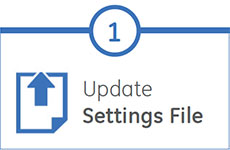
EnerVista 8 Series Setup Software provides automated setting file conversion. Once completed, a graphical report is provided to verify and call out any specific settings that may need attention.
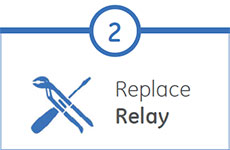
Simply remove the terminal blocks and then remove the SR chassis from the panel. No need to disconnect any of the field wiring.
Insert the new 8 Series Retrofit chassis into the switchgear and simply plug-in the old terminal blocks - there is no need to make any cut-out modifications or push and pull cables.
Manufacturing for this product has been discontinued.
EnerVista 8 Series Setup Software provides automated setting file conversion. Once completed, a graphical report is provided to verify and call out any specific settings that may need attention.
Simply remove the upper, lower and low voltage terminal blocks and then remove the SR chassis from the panel. No need to disconnect any of the field wiring.
Insert the new 8 Series Retrofit chassis into the switchgear and simply plug-in the old terminal blocks - there is no need to make any cut-out modifications or push and pull cables.